


The multimedia project
What you’re scrolling through on your virtual desktop or physically holding in your hands is in some ways a text, but it’s also a great deal more than that. The Pathways Project departs from a stand-alone, linear text in two fundamental ways.
First, the online version of the Pathways Project consists of a network of linked nodes that presents the contents of the book but also adds many connections and opportunities that books just can’t support.
Second, even the brick-and-mortar book, entitled Oral Tradition and the Internet: Pathways of the Mind, is not simply a conventional text. It’s a morphing book, capable of being read in innumerable different ways.
In other words, you can surf the online facility or you can “read” the book, but in either case your experience will differ from the usual text-consuming scenario. More about those two options in a moment, but first a word about the general thesis of the Pathways Project.
The homology
The goal of the Project is to explain and illustrate a central thesis—namely, that humankind’s oldest and newest thought-technologies, oral tradition and the Internet (abbreviated throughout as OT and IT), are fundamentally alike. Hardly identical, of course, but surprisingly similar in their structure and dynamics.
And how are they alike? Both media depend not on static products but on continuous processes, not on stationary points but on vectors with direction and magnitude, not on “What?” but on “How do I get there?” In contrast to the fixed, spatial linearity of the conventional page and the book, the twin technologies of OT and IT mime the way we think—by navigating along pathways within an interactive network.
In both cases, then, it’s linked pathways—and not things—that matter. OT and IT don’t operate by spatializing, sequencing, or objectifying. They don’t fossilize ideas into free-standing museum exhibits, as books typically do. Instead, they invite and require active participation and support a rich diversity of individual, one-time-only experiences. In place of the single, predetermined route typical of texts, they offer myriad different routes for exploration by engaging each user in nothing less than co-creating his or her own contingent reality.
This built-in, rule-governed variability marks the crucial difference between the closed arena of a textual script—what we’ll be calling the tAgora—and the open, multiform environment of oral tradition and the electronic world of the Internet—the oAgora and eAgora, respectively. Because of their inherent dynamics, both OT and IT are always in flux; they remain open, emergent, and forever under construction rather than closed, determined, and complete.
Key terminology: o-, e-, and t-
Before we turn to the question of how to surf the online network and read the morphing book, let’s add a brief note on terminology. Throughout both modes of presentation, we’ll be using an extended version of web-speak to describe words, pathways, and other phenomena across the three agoras. Thus oral words will be oWords, electronic pathways will be ePathways, textual agoraphobia will be tAgoraphobia, and so forth.
Surfing the wiki
Instead of wrestling with the built-in barriers of book technology and the tAgora, the online facility allows you to fashion a unique, individualized encounter with its assets by choosing among practically innumerable combinations of pathways. Instead of interpreting a monolithic text, you immerse yourself in a wiki, a collaborative electronic space where you can choose your route and contribute in various ways. In practical terms, you are responsible for molding the wiki’s networked, interactive contents into your own personal experience. You are an active participant in charge of a process: you set the agenda and prescribe the itinerary. And your experience happens—actually takes living shape—even as you click through the network. Note that the Pathways Project wiki supports contributions—in the Contributions node—but not direct editing of pre-existing contents.
Options
Here are four ways you can proceed:
1. Via the default method: “straight through”
The Pathways Project wiki can be read straight through, so to speak, by following the alphabetical order given in the Full Table of Nodes continuously available in the lefthand menu-bar. Mirroring the page-turning sequence of Oral Tradition and the Internet: Pathways of the Mind (itself only one choice among myriad alternatives), this nominal sequence amounts to merely one of many potential routes through the network.
2. Via the three principal media environments
Another way to surf the wiki is to focus on one of the three principal media environments—the oAgora, tAgora, and eAgora—that lie at the heart of the OT-IT thesis and at the foundation of the Pathways Project as a whole. All three agoras are always accessible from the top menu-bar.
The oAgora is the word-marketplace or the arena for oral tradition, the “place” where OT is performed for audiences. As demonstrated elsewhere, it serves as the site for humankind’s oldest and most pervasive communications technology. The tAgora, next in historical succession, names the communications technology that involves the creation of texts as cognitive prostheses for thinking and exchanging ideas. The eAgora, or electronic marketplace, is of course the virtual world of the Internet and digital media. Today these technologies co-exist in a complex array of media channels, a situation that the Pathways Project aims to represent as well as explain.
If you choose to start with one or more of these three major ideas, you can then proceed from that basic frame of reference to any other part of the wiki. (One radical advantage of this eTool is that you’re offered numerous opportunities to explore related links at any and all points in your “reading”.)
3. Via linkmaps
Linkmaps amount to suggested routes through the wiki network, particular sequences of ePathways that we have clicked through and found illuminating in one way or another. An example is the eWorld, a linkmap of nodes that leads from Leapfrogging the Text to The Museum of Verbal Art to The Irony of Proteus to Resynchronizing the Event to Systems versus Things. En route the surfer will have an opportunity to think about a textless world, the new-media landscape for literature and oral tradition, an ancient Greek myth of transformation, the re-creation of performance events, and communication without “things.” What’s more, the entire itinerary revolves around the core OT/IT thesis of the Pathways Project.
But that’s just one option. Potential surfers may opt to follow this or some other predesignated pattern (any of which they can always exit at any point). Or they may choose to strike out on their own, fashioning their own experiences at every juncture—effectively creating their own linkmaps as they go. The freedom to explore and to construe is nearly absolute, and all we ask in return is that surfers consider the option of contributing their newly discovered itineraries to the Pathways Project linkmap digest as possible “guidebooks” for future users.
4. Via branches
All topic nodes contain multiple branches, links that allow navigation to other nodes related in some fashion to the particular idea under discussion. As with other aspects of the online facility, the choice of how to proceed rests with the surfer. You may decide to keep on reading past the branch or to “depart” the present topic node for another destination. Of course, the whole point of the online digital configuration is to erase the tAgora notion of departure and to image the pathways of OT and IT.
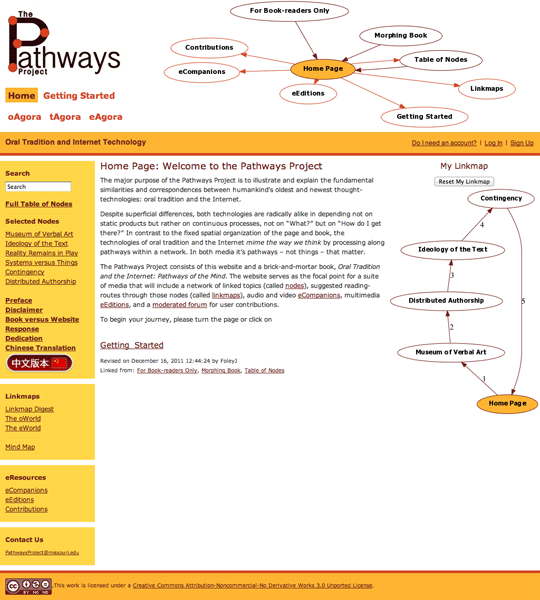
Here is a screen shot of the Pathways Project wiki with all of its features described simply:
Welcome to the Pathways Project
A Brief Tour of the Pathways Project Home Page
[This section is intended most immediately for those of you who are interacting with the website, but may also serve as an incentive and guide for readers of Oral Tradition and the Internet: Pathways of the Mind who wish to explore the website.]
General
The features described below appear on every electronic page and will follow you wherever you travel within the Pathways Project, always available to support your co-creative surfing.
Horizontal orange menu-bar
Here you have the option of creating an account to surf the Pathways Project website. You’re welcome to surf the site without an account; it is free and open to anyone with a web connection and a browser. If you choose to establish an account, however, you can contribute linkmaps of your own design to our linkmap digest (for the benefit of others) and, eventually, offer comments, responses, and other reactions to the site.
Above the horizontal menu-bar
The animated Pathways Project logo is meant as a continual reminder of the core theorem of the Project, namely that oral tradition and Internet technology operate via navigation through networks. Just below the logo you see five orange hyperlinks. The Home link will bring you back to the home page, “Welcome to the Pathways Project,” while Getting Started will take you to a detailed explanation of how to begin using both the site and the book. The other three links – oAgora, tAgora, and eAgora – lead to the three principal media nodes: substantial discussions of the oral, textual, and electronic marketplaces. To the right of these five links is a diagram that indicates your position at the present moment (here Getting Started), which is always colored orange, along with all of the other nodes that are linked to the current node. Notice the color differentiation: all linked node-names are circumscribed by white ellipses, but “linked-to” nodes have orange arrows and outlines while “linked-from” nodes have brown arrows and outlines.
Lefthand menu-bar
The Search field is indexed by keyword; it allows you to pursue important concepts through the entire website. Just below, clicking on the Full Table of Nodes yields a complete alphabetical listing of the more than 100 nodes that constitute the Pathways Project. From this collection I have chosen six that may be of special interest and provided direct access under the heading Selected Nodes (we plan to rotate this selection periodically). Next in vertical order comes the Disclaimer, a crucially important node that emphasizes the nature of the core comparison at the basis of the Pathways Project – that oral tradition and Internet technology are meant to be understood as homologous, and definitely not as simply equivalent. We are looking at similarities, not identities. Just below this link is another entitled Response, which presents my reaction to the reports of the two anonymous reviewers commissioned by the University of Illinois Press. Under Linkmaps you will find suggested itineraries through the Project’s web, itineraries consisting of several nodes that collectively illustrate a particular topic. The Mind Map, a three-dimensional schematic, images the thousands of linkages that make the Pathways Project web the unique exploratory experience it is. The eResources box houses two kinds of electronic strategies for representing OT via IT (eCompanions and eEditions), as well as the Contributions link, which will soon offer participation typical of a wiki with gatekeeping. Finally, the Contact Us e-mail allows users to share impressions, report problems, and make suggestions.
“My Linkmap” Feature
As you surf through the Pathways Project, the My Linkmap feature will track your progress wherever you go. Arrows and numbers indicate the sequence of your clicking, and the node where you presently are will be marked in orange. For example, in the screen shot above, the surfer started on the Home Page, then moved on to the Museum of Verbal Art, followed by the nodes on Distributed Authorship, Ideology of the Text, and Contingency before returning to the Home Page. At any point you can erase your linkmap simply by clicking on “Reset My Linkmap,” and the tracking process will begin anew from your present location.
Bottom bar
The Pathways Project is licensed for use under a Creative Commons contract that can be viewed by clicking on the link.
“Reading” the morphing book
Contents
The contents of Oral Tradition and the Internet: Pathways of the Mind, the brick-and-mortar aspect of the Pathways Project, consist of items eligible for exchange within the tAgora, plus a few unusual options. That is, the book contains all of the electronic node-texts composed and posted as of its date of issue, its copyright date. Naturally enough, it cannot house any subsequent additions unless it proceeds to a second edition, which would in turn involve a sequel set of limitations. The truth is that by their very nature books can’t remain open-ended or under construction (as OT and IT can and must).
Options
Unlike conventional books, Oral Tradition and the Internet: Pathways of the Mind is built and intended to be “read” in multiple, alternate ways. Of course, a book is not a website; no text can ever wholly emulate the virtual arena. But to the limited degree that the tAgora allows, you will be able to “sort” your experience according to facsimiles of the four reading strategies available in the online wiki:
1. Via the default method: “straight through”
You can opt to march straight through from the opening page to the last, like a novel-reader tracking the story as it unfolds according to a singular, fixed blueprint. This alphabetical order is intended to mirror the default logic of the tAgora, but without the customary hierarchy of chapters, sections, and other book-matrices that act as cognitive and rhetorical support for the reading process. As in the wiki, the “straight through” order is merely alphabetical, and is probably best likened to reading page after page of definitions in a dictionary, or trolling through a telephone directory in ruthlessly linear sequence, name after name. Each of the nodes is (hopefully) interesting and helpful, but responsibility for assembling them into a coherent whole rests in large part with you, the reader.
2. Via the three principal media environments
Or you can read according to any of the three principal media environments—the oAgora, tAgora, or eAgora. Once you reach your chosen agora, more options await you within that section. You’ll need to flip back and forth in uncustomary (because non-linear) ways, but you will be able to manufacture a partial facsimile of what the wiki offers along these lines. It’s an awkward repurposing of tAgora technology, but that very awkwardness exposes the fundamental assumptions of the book-and-page medium.
3. Via linkmaps
You can decide to use one or more of the linkmaps that are also available in the volume’s opening pages, a set of predesignated itineraries that are offered as alternate viable routes from through Pathways Project contents. Of course, you won’t be able to exit and re-enter the prescribed sequences as easily as in the wiki, but such is the nature of eAgora strategies deployed non-natively within the tAgora. There aren’t any “back” buttons or clickable links in the book.
4. Via branches
You can exercise any of myriad options to explore the branches that are contained within each node, but here the book really struggles to morph acceptably. It’s inconvenient to interrupt the linear page-to-page logic too often if you can’t immediately return to your point of departure with a simple click. More tellingly, all those branches that lead to external media-rich sites are effectively dead; audio, video, and the like can’t be forced between two covers. You can explore branches with a mouse in one hand and the paperback in the other, of course, but there are built-in constraints on to how far the book itself can morph to imitate eAgora (and oAgora) technology.
Experimental limitations
Naturally, the inter-agora experiment can go only so far before agoraphobia sets in. We can’t wholly retool book technology and force it to become something it isn’t. Pages, paragraphs, chapters, and other dimensions of order-by-sequence constitute a cognitive rhetoric seated deep in our text-disposed psyches, so deep that it functions as automatically and invisibly as a computer’s operating system, well below the level of conscious awareness. Like it or not, our thinking and communication process has been defaulted—tDefaulted, in fact.
But to the extent that the medium of texts can support more than the usual slate of textual activities—and that’s precisely the experiment we’re conducting with Oral Tradition and the Internet: Pathways of the Mind —you can “click through” this morphing book, charting your own idiosyncratic route as you go. No “hard” text can ever entirely simulate OT or IT, of course; it may morph to an extent, but it’s still a book. If suggestively constructed, however, it can accomplish two related goals. It can remind us how those non-linear, participatory technologies work even as it reveals the inherent conditions of exchange within the tAgora marketplace.
There’s a good reason our experiment can be pushed only so far.
One last point before you get started….
One small but fundamental caveat before you begin. You’ll notice that certain topics will recur over the various nodes of the Pathways Project. You will have an opportunity to weigh their importance in a number of different contexts as well as numerous chances to visit every node in the network. Let me be clear: this is a wholly intentional aspect of both the morphing book and the online wiki, a crucial feature that has been “written into” both components for two purposes.
1. First, the dynamic difference between recurrence and repetition is a key theme of the Pathways Project. And the contrast aligns with the homology between OT and IT on the one hand, as opposed to textual technology (TT) on the other.
Repetition demands a linear framework with a predetermined sequence, in other words a tAgora environment. Each instance refers back to the previous instance(s) for its meaning. This cognitive set-up can generate emphasis or ennui: repetition can be effective or annoying, depending on how the author handles the transaction.
Recurrence happens independently each time, with meaning invested idiomatically and equivalently in each occurrence. Phrases such as “Once upon a time” are recurrent, not repetitive, in that they signal an event about to emerge—in this case a Grimm Brothers fairytale. Recurrence is typical of web-navigation in the oAgora and eAgora.
2. Second, I have built recurrence into the Pathways Project to empower exploration. Just as there should be more than one set of pathways to navigate, so there should also be more than one way to “get there”—wherever “there” may be. No matter how you choose to surf, you should have ready access to core ideas and many different avenues leading to every destination.
Remember: you won’t have the one-way street of the text guiding you and making your decisions for you, determining every move you make by meticulously mapping the exclusive itinerary ahead of your journey. To take up the cognitive slack, I have created multiple opportunities at every juncture that will allow and support many different itineraries, with the starting, ending, and intermediate points left for you to decide as you go. Recurrence keeps the network functional and co-creativity alive.
As you work your way through the Project, navigating pathways as you see fit in either the morphing book or the online wiki, please keep this most basic of mantras in mind: OT and IT recur, TT repeats.
